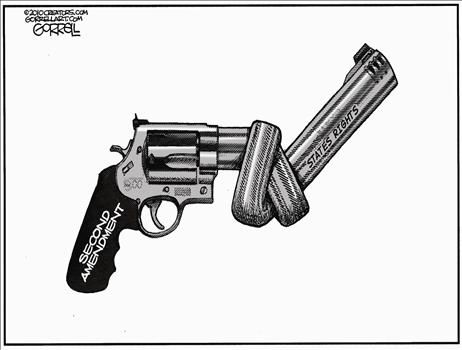
 The next battle for our constitutional right to keep and bear arms was fought yesterday as the U.S. Supreme Court heard arguments to overturn the Chicago ban on handguns. It's looking pretty good, according to the NRA and other sources. The Washington Times sums it up thusly:
The Supreme Court majority that two years ago ruled a near-total ban on handguns in the District to be unconstitutional seemed equally willing on Tuesday to extend the Second Amendment's right to keep and bear arms to the states.The NRA, which filed the suit to overturn Chicago's city handgun ban, is more diplomatic.
As a party to the case, NRA argued before the U.S. Supreme Court today that the Second Amendment protects the fundamental, individual right to keep and bear arms no matter in which city or state one resides. We are optimistic the Court will hold that the Second Amendment applies to state and local governments through the Fourteenth Amendment and that handgun bans, like those in the City of Chicago and the Village of Oak Park, are unconstitutional under any standard of judicial review. This view is shared by a bipartisan group of 309 members of Congress from both chambers, 38 state attorneys general and the majority of the American people. We look forward to the decision by the Court later this Term.Townhall.com columnist Jacob Sullum is far bolder, saying the court will rule against Chicago.
On Tuesday, the Supreme Court considered the question of whether the Second Amendment applies outside of jurisdictions controlled by the federal government. The court will almost certainly say yes, and soon it may consider a question that should be equally easy to answer: whether the Second Amendment applies outside of the home.And Sullum looks beyond Chicago's presumed victory and asks "What's next?" His answer is the right-to-carry nationwide, instead of the patchwork quilt of state laws we current have.
Assuming the court strikes down Chicago's handgun ban, what other forms of gun control could be vulnerable? Since the Second Amendment protects the right to "bear" arms as well as the right to "keep" them, restrictions on carrying guns in public are a ripe target.From the mouth of the gun-banner on the Supreme Court bench comes truth. If we have a right in the Constitution to keep and bear arms in the home, why not the same rights outside home?
Forty-one states either do not require handgun carry permits or issue them to anyone who satisfies a few objective criteria, which generally include firearms training and lack of a criminal record. Seven states let local officials decide whether to issue permits, while Illinois, Wisconsin and Washington, D.C., do not allow even that option.Last summer, Tom Palmer, one of the original plaintiffs in the D.C. gun-ban case, filed a federal lawsuit that challenges the District's prohibition on carrying guns in public. Palmer, a scholar at the Cato Institute, knows from personal experience that such restrictions can be deadly: He vividly recalls how brandishing a handgun on a Northern California street saved him from a group of thugs who shouted anti-gay slurs and threats at him on a summer night in 1982.
District officials predictably warn that chaos would ensue from allowing law-abiding people to carry guns in public. But that has not happened in any of the states with nondiscretionary carry permit policies.
Although the crime-reducing benefits of such policies remain controversial, the blood-soaked visions of doomsayers who imagined routine arguments regularly culminating in gunfire have not transpired in the two decades since Florida started the trend toward liberalization. In fact, data from Florida, Texas and Arkansas indicate that permit-holders are far less likely to commit gun crimes (or other offenses) than the general population.
The experiences of these jurisdictions show there is no safety benefit from prohibiting public carrying of guns that could possibly outweigh the Second Amendment interests at stake. Palmer and his co-plaintiffs concede that a city or state may bar guns from "sensitive places such as schools and government buildings" or regulate the manner in which they are carried -- policies that the Supreme Court called "presumptively lawful" in its 2008 decision. But they argue that the Second Amendment cannot reasonably be read to allow "a total ban on the exercise of the right to bear all arms, by all people, at all times, for all purposes."
The Supreme Court said a handgun ban is especially problematic when it extends to "the home, where the need for defense of self, family and property is most acute." But in his dissent, Justice John Paul Stevens worried that the D.C. ban "may well be just the first of an unknown number of dominoes to be knocked off the table," in light of "the reality that the need to defend oneself may suddenly arise in a host of locations outside the home.
I know, logic has nothing to do with Supreme Court decisions. But maybe this time, it will.
Extending concealed-carry rights nationwide is certainly the "Holy Grail" of this 2nd Amendment fight. The founding fathers had exactly that in mind when they penned the 2nd.


 Posts