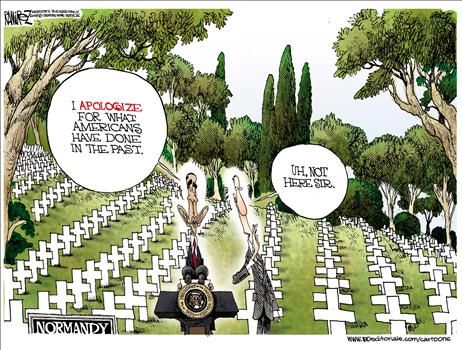
 President Obama's got "I" trouble. Stanley Fish, a Noo Yawk Times op-ed blogger (seriously. He assumed the role of the token rightwinger after they kicked Bill Kristol out) gives us the chronology on how Obama has advanced from the "Yes we can" of the campaign, presumably inclusive of the voters who he was humbly seeking to include in his ascent to power, to the "royal we" once he assumed power, into the current "I" which is his just plain naked narcissistic hubris.
Everything alters in the inaugural address (Jan. 20, 2009). The promises are now made to an America that is asked only to stand by while they are fulfilled. “Today I say to you that the challenges we face are real. They will not be met easily or in a short span of time. “But know America” — or, in other words, “hear me” — “…they will be met.” And later, when he says, “We will build the roads and bridges… We will restore science to its rightful place… We will harness the sun and winds,” the “we” is now the royal we: just you watch, “All this we will do.”
By the time of the address to the Congress on Feb. 24, the royal we has flowered into the naked “I”: “As soon as I took office, I asked this Congress.” “I called for action.” “I pushed for quick action.” “I have told each of my cabinet.” “I’ve appointed a proven and aggressive inspector general.” “I refuse to let that happen.” “I will not spend a single penny.” “I reject the view that says our problems will simply take care of themselves.” “I held a fiscal summit where I pledged to cut the deficit in half by the end of my first term.” That last is particularly telling: it says, there’s going to be a second term, I’m already moving fast, and if you don’t want to be left in the dust, you’d better fall in line.
There’s no mistaking what’s going on in the speech delivered last week. No preliminary niceties; just a rehearsal of Obama’s actions and expectations. Eight “I”’s right off the bat: “Just over two months ago I spoke with you… and I laid out what needed to be done.” “From the beginning I made it clear that I would not put any more tax dollars on the line.” “I refused to let those companies become permanent wards of the state.” “I refused to kick the can down the road. But I also recognized the importance of a viable auto industry.” “I decided then…” (He is really the decider.)
 And perhaps at long last the voters are beginning to awaken from their long slumber and as the late Sen. Jesse Helms would say, smell the coffee. And guess what? It's burning on the stove. Thomas D. Johnson at the Weekly Standard Blog reports Obama's numbers rising and falling.
It looks like good opinion and bad opinion are starting to meet in the middle for Obama. Rasmussen reports that the President’s "strongly approve" rating has fallen from roughly 42 percent to roughly 32 percent since Inauguration Day, while his "strongly disapprove" rating has risen from roughly 14 percent to roughly 32 percent. Seems like faith in rhetoric is being replaced by frustration with reality.


 Posts
Posts