Showing posts with label WWII. Show all posts

Saturday, February 20, 2010

1911 pistol vs. Panzer tank: 1911 .45 pistol shooter wins

And it's my blog so if I want to quote myself, I can and will. Here's another hero of the Battle of the Bulge in WWII that I wrote about after meeting his brother in recent years.

1911 pistol vs. Panzer tank: 1911 wins

By John Myers, Internet Photojournalist

The Medal of Honor
1911 .45 ACP

The Medal of Honor is our nation's highest military award and a surprising number of those who earned it since its introduction just prior to World War I did so with the help of a 1911 .45 ACP Government Pistol or a 1911-A1 model.

Perhaps the most famous of these was Sgt. Alvin York in WWI.

He was awarded the Medal of Honor for leading an attack on a German machine gun nest, taking 32 machine guns, killing 28 German soldiers and capturing 132 others during the U.S.-led Meuse-Argonne Offensive in France.

He was made even more famous by Hollywood in the 1941 movie, "Sergeant York," which York allowed to be made on one condition, that Gary Cooper play the lead role.

But as usual, Hollywood got the details wrong, particularly in regards to the weapons York used.

The movie shows York/Cooper using a captured German Luger pistol in addition to his rifle to kill and capture a host of Germans.

Wrong! He used a Government Model 1911 .45 ACP pistol.

Also, the movie shows York with a Springfield 1903 rifle but he actually used a M1917 Enfield rifle. Wrong again! Similar rifles, both are 30'06 bolt-actions, but different models.

Everybody's heard of the famous Sergeant York, who actually was a corporal when he earned his medal of honor.

But I ran across another familiar name while reading a July 2000 American Handgunner article by Barrett Tiliman, The 1911 And The Medal Of Honor.

As I was reading through the pantheon of heroes, I found a familiar one most Americans never heard of, another corporal who took on the Germans with a 1911, this time in World War II.

Tillman writes that in the 75 years from 1918 to 1993, at least 55 Medals of Honor were presented to men carrying the .45 ACP.

This includes 20 known in World War II, a dozen in Korea, seven in Vietnam and, finally, two in Somalia.

The exact total, however, is unknown, as most citations only refer to "pistol" or "revolver" and some famous events do not mention sidearms at all.

As Tillman listed the WWII MOH winners who used 1911s, that familiar name surfaced:

Medal of Honor winner Cpl. Henry F. Warner

"Not only infantrymen used the service pistol in Medal of Honor actions. Two tankers were decorated for their exploits in France that October, and in December Cpl. H.F. Warner of the Big Red One used a bazooka and his Colt to stop a German armored thrust.

"Warner's citation says he won a pistol duel with the commander of a Panzer threatening to overrun his position; the tank withdrew."

Back in the early '90s, while I was working as a weekly newspaper editor, I interviewed the brother of Medal of Honor winner Cpl. Henry F. Warner of Troy, NC, who told me about how this hero died.

57 mm M1 anti-tank gun of the 44th Infantry Division in France, 1944.

Tillman got one detail wrong, Warner didn't use a bazooka along with his 1911 Colt against the German tanks.

He used a 57mm anti-tank gun, a design we "borrowed" from the British, a notoriously underpowered artillery piece which was also prone to jam.

This weapon also offered scant protection for the gunner, who stood out in the open to fire it, the only "protection" being a single sheet of metal to duck down behind when taking fire.

His brother showed me Henry Warner's detailed Medal of Honor citation, which noted that his accurate fire with the 57mm gun was able to knock out the heavily armored German tanks only by hitting their one vulnerable spot as he maneuvered the small artillery piece like a squirrel rifle.

In the end, his refusal to retreat as he kept trying to clear his jammed 57mm while a German Mark IV Panzer tank attacked is what cost him his life.

1911 vs. Panzer tank: 1911 wins

Tillman accurately describes the famous 1911 episode on Dec. 20, 1944, when Warner knocked out two German tanks with his 57mm before his anti-tank gun jammed. The commander of a third tank saw Warner's gun was jammed and elected to finish him off personally with his pistol. Bad mistake.

Warner outshot the German in a pistol duel, killing the officer with his 1911 and forcing the tank to withdraw.

Here's a short version of Warner's Medal of Honor citation which covers his heroic fight during two days' actions in the Battle of the Bulge.

WARNER, HENRY F.

Rank and organization: Corporal, U.S. Army, Antitank Company, 2d Battalion, 26th Infantry, 1st Infantry Division. Place and date: Near Dom Butgenbach, Belgium, 20-21 December 1944. Entered service at: Troy, N.C. Born: 23 August 1923, Troy, N.C. G.O. No.: 48, 23 June 1945. Citation: Serving as 57-mm. antitank gunner with the 2d Battalion, he was a major factor in stopping enemy tanks during heavy attacks against the battalion position near Dom Butgenbach, Belgium, on 20-21 December 1944.

In the first attack, launched in the early morning of the 20th, enemy tanks succeeded in penetrating parts of the line. Cpl. Warner, disregarding the concentrated cannon and machinegun fire from 2 tanks bearing down on him, and ignoring the imminent danger of being overrun by the infantry moving under tank cover, destroyed the first tank and scored a direct and deadly hit upon the second. A third tank approached to within 5 yards of his position while he was attempting to clear a jammed breech lock. Jumping from his gun pit, he engaged in a pistol duel with the tank commander standing in the turret, killing him and forcing the tank to withdraw.

Following a day and night during which our forces were subjected to constant shelling, mortar barrages, and numerous unsuccessful infantry attacks, the enemy struck in great force on the early morning of the 21st. Seeing a Mark IV tank looming out of the mist and heading toward his position, Cpl. Warner scored a direct hit. Disregarding his injuries, he endeavored to finish the loading and again fire at the tank whose motor was now aflame, when a second machinegun burst killed him. Cpl. Warner's gallantry and intrepidity at the risk of life above and beyond the call of duty contributed materially to the successful defense against the enemy attacks.
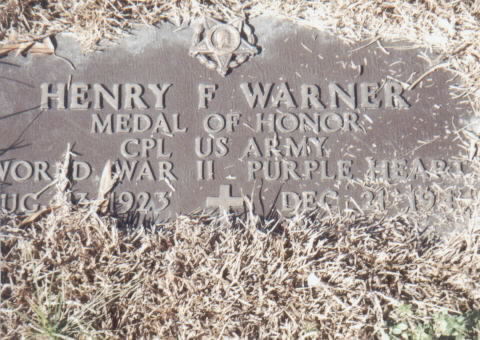
Warner's brother showed me Henry's grave in Troy and told me about his childhood, growing up poor, just another country boy who could hit anything he could see with a squirrel rifle, putting meat on the table for his family, much like Alvin York.

There's a lot of confusion among the current generation as to just who or what is a hero. My generation, the baby boomers, didn't have that problem, we had the WWII vets for heroes, like Henry F. Warner. One of my boyhood heroes was Major Dick Bong, the "Ace of Aces" who shot down 40 Japanese planes during WWII in the Pacific.

It's a telling sign of our times that the men and women fighting and dying for their country in Iraq and Afghanistan are not considered heroes by many today. Even the cop on the street, protecting our lives daily, gets little or no respect, hardly seen as heroes.

Another of my boyhood heroes was my "Uncle Howard" Jordan, who really wasn't a relative at all, just a childhood friend of my father's who treated the five kids of our family like his own. He and his wife Lena had no kids, but they often had all five of us kids stay overnight at their home.

And I remember "Uncle Howard" showing up at my school in the first grade and telling the principal he was "Johnny's uncle" and had come to pick me up early. And then we'd go fishing. I remember sitting on a wooden bridge over Drowning Creek, not catching any fish, just having a good time with Uncle Howard. I didn't even know he was a WWII vet, he was just Uncle Howard to me and he was one of my heroes.

Last time I saw him was when I was about 10 and we visited Uncle Howard in the VA hospital. He was in a wheelchair and looked so frail and tired. That's when I learned he was a WWII vet. Not long after, he died.

My dad told me that Uncle Howard had to bail out of a damaged airplane over the desert in North Africa in WWII and landed in a huge cactus patch. He wasn't rescued until several days later, still trapped in the cactus. One of those cactus spines finally worked its way into his heart many years later and killed him, my daddy told me. He also told me that every now and then after the war, Uncle Howard would go "barking mad" and howl at the moon. But he never hurt anybody. Uncle Howard never won the Medal of Honor, but he was a hero to me.

One of my favorite preachers, Ravi Zacharias, tells the story of a 3rd grade teacher who asked her class of 8- and 9-year-olds to list three people who were their heroes. One listed Michael Jackson, Madonna and Boy George (which Zacharias notes "covers all three sexes.")

But a disturbingly high number listed themselves as their own hero. Such is the result of the current educational trend to boost "self-esteem" as the most important classroom goal. Perhaps that's why there's such a strange set of heroes for the current generation.

Two G.I. riflemen who fought and won in the Battle of the Bulge

I love history and military history is right at the top of my list. Reading about the G.I. riflemen who stopped the last gasp of the Nazi war machine at the Battle of the Bulge starting just before Christmas 1944 and extending into January 1945 has always been fascinating to me.

Gen. George Patton, who was billed as one of the heroes of that battle for leading his tanks to rescue the surrounded paratroopers at Bastogne, knew who the real heroes of the battle were when he said a G.I. armed with an M1 Garand was the most potent weapon on the battlefield.

From the current issue of American Rifleman, here's the story of two of those now-forgotten riflemen in The Men & Guns of the Battle of the Bulge.

The first G.I. took part in a bayonet charge in the fog, the second one started a battle with his Garand and finished it with an MP40 submachine pistol captured from a dead German soldier. Neither would quit until the job was done.
In early January 1945, an Allied counter-offensive struck the salient and produced still more intense combat in the bitter cold. At this time, the 551st Parachute Infantry Battalion was attached to the 82nd Airborne Division fighting on the north shoulder of the “Bulge” near Trois Ponts. Pvt. Joe M. Cicchinelli of A Company, 551st was one of those cold, shivering paratroopers, and he looked on as the men of B Company began an attack on the village of Dairomont on Jan. 4, 1945. When that attack ran into enemy machine guns concealed by heavy mist and fog, it began to stall. Cicchinelli’s platoon leader quickly realized that blindly firing into the mist might result in friendly fire casualties, so he gave the only command that made sense: “Fix bayonets!” Cicchinelli obediently drew his bayonet from its scabbard and mounted it on the lug at the muzzle of his M1 Garand rifle. At the command of “Charge,” they all rushed toward the Germans yelling and shouting. “We reached the enemy position, and leaped from foxhole to foxhole, thrusting our bayonets into the startled Germans,” Cicchinelli recalled. It was over in minutes and 64 enemies lay dead on the battlefield. Dairomont had been captured by a handful of determined American riflemen at the point of the bayonet.

Meanwhile on the opposite side of the “Bulge” salient, the 80th Infantry Division attacked the left flank of the German Seventh Army near Ettlebruck, Luxembourg. On Jan. 8, the 1st Battalion, 394th Infantry advanced to a plateau three miles southeast of the city of Wiltz with B Company occupying the tiny farming village of Dahl. As the company moved in, a nine-man squad lead by Staff Sgt. Day G. Turner was sent to establish a flank outpost at Am Aastert, a farm on the northeastern edge of the village. There, Turner’s men dug foxholes in the frozen pasture facing north toward the neighboring village of Nocher, less than a mile away across a gently sloping ravine.

Shortly before noon, German artillery began to fall on Am Aastert and enemy infantry advanced from Nocher into a stand of pine trees in the ravine. When the enemy emerged from the tree line and charged uphill toward the farm, Turner’s men began to drop them with accurate fire from their M1 rifles at 300 yards. Having failed with the first attack, the Germans pounded the farm again with a mortar and rocket barrage that drove the nine Americans from their foxholes and into the farm house.

Under the cover of the renewed barrage, enemy infantry attempted to cross the ravine and overrun Am Aastert again. This time, Turner and his men directed accurate rifle fire on them from open windows on the second floor—repulsing the second assault with heavy German losses. Undeterred, the Germans sent forward a third assault, this time with tank support. The enemy quickly stampeded toward Am Aastert as accurate mortar fire rained down around the house, killing one of Turner’s men. When German infantry finally reached the farm, the mortar fire lifted, and they closed in on the eight surviving Americans.

From his position on the second floor, Turner heard a German voice order some of the troops to charge the building. Determined to keep them out, he rushed to the top of the stairs and fired into a mass of five Germans as they attempted to climb them. But his Garand only gave him two shots and then locked open with a ping as the empty en bloc clip ejected from the rifle. The survivors pushed the bodies of the two dead aside and continued climbing the stairs toward Turner with his now-empty rifle. Out of ammunition, the 24-year-old staff sergeant reached for the closest object that could be used as a weapon: a nearby oil lamp. Turner hurled the lamp down the stairs at his antagonists, and when it shattered it engulfed them in flames. They immediately fled the building on fire, but then a second wave of attackers rushed in.

Turner tossed a grenade down the stairs toward them and dashed into another room to shelter himself from the explosion. After the blast, Germans stormed into the hallway of the second floor and Turner met them in the doorway where he bayoneted two of them before they could raise their weapons. Turner then grabbed an MP40 from one of the dead Germans and used it as he fought from room to room. Although five of his men had been wounded, he refused to surrender and led the remaining two unwounded soldiers as they mopped up what was left of the German assault force.

When they emerged from the house, they found dazed and wounded Germans anxious to surrender—25 in all. The bodies of 11 German dead littered the farm—most killed by Turner himself. His exceptional actions ultimately resulted in Turner being awarded the Medal of Honor on June 28, 1945, but he never wore it or knew he had received it. One month to the day after his heroic actions at Am Aastert, Turner was killed in action.

By the end of January, the Bulge salient had been reduced, and American lines returned to where they had been before the Germans launched their offensive. It was the largest battle that the U.S. Army fought during the Second World War, and the cost was enormous, with 19,000 killed in action and almost 50,000 wounded. The German casualties were even worse: 91,000 killed, wounded and missing. But for all the enormity of it, the Bulge was very much a rifleman’s battle where soldiers such as Joe Cicchinelli and Day Turner marked the difference between defeat and victory.

As the Hebrews Chapter 11 says of the heroes of the faith, the world is not worthy of such men. One of them survived, Pvt. Joe M. Cicchinelli, and he will be at the NRA Annual Meeting in May in Charlotte and I hope to meet him there and thank him for his service to our nation.

Thursday, January 28, 2010

WWII Ithaca M1911A1 customized into beauty in deep blue and pearl

I need another 1911A1 .45 like I need two more holes in my head.

I've got two full-size 1911 .45s, both wide-frame 15-shot models, one a Para-Ordnance P14-45 heavily customized and the other a customized Llama IX-C.

Plus I've got a compact 1911 Para-Ord P12-45, also customized, which is a 12-shot model.

So I need a single-stack 7-shot 1911, as I said, like I need more holes in my head. I've always believed more is better, particularly when it comes to pistol capacity and 12 or 15 rounds beats seven or eight rounds all day.

But if I had unlimited funds, a 1911A1 I shot photos of and listed on gunbroker would have never made it to the counter at the gun shop where I work.

It's a match customized Ithaca M1911A1 and it is just plain beautiful.

This Ithaca M1911A1 U.S. Army .45 ACP has been refinished a deep, dark blue and customized for match shooting with new front and rear target sights, adjustable trigger and National Match barrel bushing. The bluing has one tiny nick on the front-right slide, two small nicks on the left slide and slight wear at the front of the slide. The bore is unblemished, bright and shiny.

If in original condition this Ithaca M1911A1 would be worth considerably more than we've priced it, but it's a beautiful pistol to be proud of and should be a great match shooter, too.

And if you don't think this Ithaca .45 is beautiful, from its deep blue finish to the pearl grips, you have my sympathy 'cause you just ain't got no soul.

And it can be yours for a mere $950.

Monday, May 25, 2009

Lest we forget: A WWII Bataan survivor's sketches


The current generation has vaguely heard there was something called World War II and most of them probably can't tell you what decade it was fought in, much less anything about it, like the Bataan Death March in the Philippines, where thousands of U.S. and Allied soldiers died. One of the survivors was an Army private named Ben Steele, whose story is told today in The New York Times.
IN the fall of 1940, Ben Steele, a 22-year-old Montana ranch hand, enlisted in the Army Air Corps at the prodding of his mother. A year later, his unit, the 19th Bombardment Group, was shipped to Clark Field in the Philippines, part of an unsuccessful American effort to deter Japanese aggression in the Pacific. (Soon after Private Steele arrived, the Japanese attacked Pearl Harbor and then the Philippines.)

Private Steele then took part in the first major land battle for America in World War II, the battle for the peninsula of Bataan in the Philippine Islands — a 99-day fight that ended on April 9, 1942, in the surrender of more than 76,000 men under American command, the worst defeat in United States military history.

Afterward, the Japanese set their sick and starving American and Filipino captives on a 66-mile walk under a broiling sun to prison camp, an infamous trek now known as the Bataan Death March.

Early in his three years of captivity, Private Steele, crippled by malaria, jaundice, blood poisoning and beriberi, became an invalid in a prisoner-of-war hospital in Manila. One day during his slow recovery, he pulled a burned stick from a cooking fire and started making scratches on the concrete floor. With some tutoring from a fellow prisoner who was an engineer, those scratches turned into sketches, and soon cellmates were scrounging paper and stubs of pencil for him.

When Navy P.O.W. doctors noticed Private Steele’s talent, they suggested that he secretly begin to document their experience. He made 50 such sketches, which an Army chaplain hid in the false bottom of a Mass kit. The chaplain was then shipped to a prison camp in Japan, and en route his vessel was sunk by American aircraft. Though the chaplain survived, Private Steele’s sketches ended up at the bottom of the South China Sea.

When he returned home to Montana after the war, Mr. Steele began to recreate and refine his early work, filling scores of sketchbooks. His aim, he says, has always been “to remember” — to remember the more than 10,000 American prisoners from the Philippines who died in Japanese captivity from April 1942 to August 1945.
God help us, here we are today making a big deal politically out of three, count 'em, only three terrorists who were directly involved in the terrorists attacks on America on 9/11, who had water poured on them until they thought they were drowning. Waterboarding my hindquarters! What the Japanese did in WWII to our troops makes waterboarding sound like a picnic.

Monday, April 13, 2009

8 Inglorious Basterds kill Nazis behind German lines in WWII

I do love good war movies. The Dogs of War is one of my all-time favorites and I could watch the Guns of Nazarone a dozen times in a row without getting bored. Kelly's Heroes is another classic that comes to mind. John Wayne's In Harm's Way is his best war flick, IMHO.

I liked Brad Pitt as the cocky younger brother in A River Runs Through It and maybe he's old and wrinkled enough now to play a decent warrior. Here's his latest, Inglorious Basterds, a new film by Quentin Taratino, a WWII tale about 8 G.I.'s behind German lines killing Nazis. I have no idea why Tarantino can't spell bastards properly.

Wednesday, February 4, 2009

How the 'Greatest Generation' supported their troops

The Greatest Generation is almost completely gone as the World War II veterans pass on and I wonder what history will say about this generation. I strongly doubt there will be any stories like this one to tell about us. Maybe so, but it doesn't have to be that way. Go to militaryministry.org.
When the "Greatest Generation" passed through North Platte, Nebraska during WWII, they got a hug and a handshake, homemade cakes and cookies, and a moment of respite and prayer provided by thousands of volunteers from the surrounding communities. This spirit of service is vital to America today. You can give something back to our military members and their families. Visit militaryministry.org to see how!