
General David Petreaus performed a miracle on the battlefield of Iraq as the leader that turned what appeared to be a sure defeat into a victory for our troops. But off the battlefield, Petreaus was instrumental in another miracle, when he uttered a single word that brought a wounded soldier back from the darkness and into the light. The word is the motto of the 101st Airborne, "Curahee!" immortalized in "Band of Brothers" by Stephen Ambrose.
Lieutenant Brian Brennan was severely wounded in Iraq and faced unbeatable odds but he made a remarkable recovery with a little help from that special Cherokee word.
Showing posts with label Petraeus. Show all posts
Showing posts with label Petraeus. Show all posts
Wednesday, September 30, 2009


Monday, October 6, 2008
CinC Choices: Win Iraq War or 'Cut and Run'
Military expert Barack Obama talks about our troops in Afghanistan "air raiding villages and killing civilians."
The differences between how John McCain or Barack Obama as Commander in Chief would handle the war in Iraq are quite clear. Both say they want to draw down forces in Iraq and increase forces in Afghanistan, but how and when reveals their stark differences in approach.
Michael Gordon, New York Times correspondent in Iraq, interviewed both candidates on their plans as Commander-in-Chief of the Iraq war.
The differences between how John McCain or Barack Obama as Commander in Chief would handle the war in Iraq are quite clear. Both say they want to draw down forces in Iraq and increase forces in Afghanistan, but how and when reveals their stark differences in approach.
Michael Gordon, New York Times correspondent in Iraq, interviewed both candidates on their plans as Commander-in-Chief of the Iraq war.
They ... provided telling clues about how much flexibility the next commander in chief would grant to his generals, including Gen. David H. Petraeus, the former top American general in Iraq who has been named to lead the Central Command, which oversees operations in the Middle East and Afghanistan.
Mr. Obama, who noted that General Petraeus wanted “maximum flexibility” in setting withdrawal schedules, said he “pushed back” when he met with the commander in July by making the case for sending more forces to Afghanistan, which the Democratic candidate views as the main battleground against terrorists.
Mr. McCain, who argued that a favorable outcome in Iraq is vital for American strategy in the Middle East and its overall efforts against terrorists, repeatedly invoked General Petraeus’s counterinsurgency strategy and said he would be inclined to give General Petraeus considerable latitude in setting force levels in Iraq.
So Obama says he "pushed back" during his sole meeting with Gen. Petraeus, when the architect and leader of the successful surge that turned the war from defeat into victory asked for "maximum flexibility." Translation: Obama told Petraeus "It's my way or the highway."
McCain, a decorated war hero and Naval air wing commander, says he will give General Petraeus "considerable latitude" to finish victory.
At the heart of the dispute is Mr. Obama’s 16-month schedule for withdrawing American combat brigades, a timetable that is about twice as fast as that provided for in a draft American and Iraqi accord. Would that deadline spur the Iraqis to overcome their political differences and enable the United States to stabilize Iraq at far lower troop levels, as Mr. Obama asserts?
Or would it tie the hands of commanders and undermine political progress when the security gains in Iraq are still fragile, as Mr. McCain contends? How would Mr. McCain try to promote political progress and better governance in Iraq, when he insists that circumstances on the ground, not the calendar, should determine the pace of reductions?
“The danger with Obama’s rigid timetable is that it may not allow U.S. commanders to react to events on the ground,” said Toby Dodge, a specialist on Iraq at the University of London and a former adviser to General Petraeus.
Obama, who has zero military experience and zero executive experience, tells Gen. Petraeus the troops are leaving in 16 months. Period.
Mr. McCain has argued that reductions should be determined by political and military circumstances, a stance taken by Adm. Mike Mullen, the chairman of the Joint Chiefs of Staff, who told reporters in June that he favored a “conditions-based approach” that would allow the United States to continuously assess and adjust to events on the ground.
Obama "military strategy" is that an American withdrawal of troops will "force" the Iraqi government to take political actions he demands.
In addition to using troop withdrawals to try to encourage change, Mr. Obama said he would end efforts to train the Iraqi military if Mr. Maliki’s Shiite-dominated government did not take adequate steps to integrate the largely Sunni members of the Awakening movements into Iraq’s security forces.
While McCain points to progress already made militarily and politically by Iraqis has been in response to our troops winning on the ground.
By contrast, Mr. McCain argued that the improved security had finally given the Iraqis the confidence to move forward politically and economically, improving their working relationship with the American military and Ryan C. Crocker, the American ambassador in Baghdad. Threats to cut off American training or deadlines for removing combat brigades, he argued, would only prompt Iraq to become more dependent on Iran or turn to militias for security.
“For a long time, people have said threaten them with this, threaten them with that,” Mr. McCain said. “Instead, Petraeus, Crocker and others established a relationship with the Iraqi government so that they did do de-Baathification, they did do an amnesty, they passed a budget. The United States government hasn’t passed a budget.”
Democrats in charge of Congress haven't passed a budget in peaceful America, while Iraqis have done so in the middle of a war. So which government is dragging it's feet and which one is moving along faster? Iraqis have put Nancy Pelosi and Harry Reid's Congress to shame.
And a crying shame is what it would be if the next Commander-in-Chief makes our troops cut and run from a hard-fought victory in Iraq.Thursday, September 18, 2008
Gen. Petraeus: Ignored Hero of Iraq War
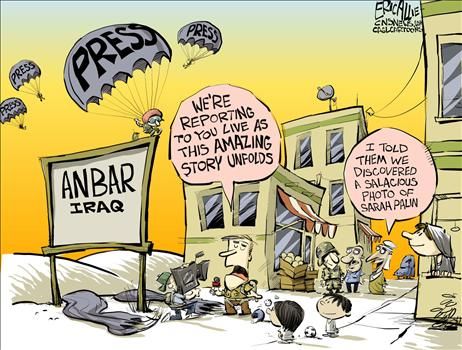 You mighta missed it on the news yesterday. It certainly didn't lead off on TV or get a big headline in The Washington Post or New York Times.
General David Petraeus, commander of our troops in Iraq, passed the baton to General Ray Odierno and moved on to a higher command post.
Petraeus was not a household name in the dark days of early 2007 as he took command of the war in Iraq. Barack Obama, Nancy Pelosi and Harry Reid were leading a baying pack of hounds, quite sure they had President Bush treed at last as they took turns with the whipsaw blades.
Then came Petraeus and the surge, which Bush supported virtually alone in his own administration and with slim backing in Congress. A senator from Arizona whose political obituary had already been written by the mainstream media was one of the few lonely voices pushing for the surge.
But as 2008 dawned, Jewish pundit Charles Krauthammer commented that he might have to revise his view on the resurrection of the dead because reports of the death of John McCain's campaign for President turned out to be greatly exaggerated. The same could also be said of the war in Iraq, because as McCain's fortunes improved, Petraeus was performing a resurrection miracle in Iraq, while at the same time performing mass reverse resurrections on Osama's thugs. Harry "The war is lost!" Reid and Nancy "Cut and run!" Pelosi grew strangely silent about the war.
Obama stubbornly refused to admit the surge had actually worked until he grew so desperate about Palin-McCain that he asked Bill O'Reilly to let him end his boycott of Fox News. And when O'Reilly pressed him about the surge, Obama cheerfully said with a straight face that the surge had "exceeded our wildest dreams!" Our dreams? I may have to revise my view of Hillary and Bill being the World Champions at telling whoppers.
Maybe it exceeded Obama's worst nightmare, but more recent events have probably taken that rank in the shapely form of one Sarah Palin.
But where is the hero's welcome home, the ticker-tape parade for Gen. David Petraeus, the hero of Iraq? I suspect he'll never get that well-deserved honor. He and his troops coming home will get roughly the same thing us vets from Vietnam got, indifference or even worse.
At Petraeus' change-of-command ceremony Tuesday in Baghdad, Secretary of Defense Williams Gates did give him an appropriate tribute.
"Darkness had descended on this land; merchants of chaos were gaining strength. Death was commonplace, and people around the world were wondering whether any Iraq strategy would work.”
"Slowly, but inexorably, the tide began to turn, our enemies took a fearsome beating they will not soon forget. Fortified by our own people and renewed commitment, the soldiers of Iraq found new courage and confidence. And the people of Iraq, resilient and emboldened, rose up to take back their country."
"Slowly, but inexorably, the tide began to turn, our enemies took a fearsome beating they will not soon forget. Fortified by our own people and renewed commitment, the soldiers of Iraq found new courage and confidence. And the people of Iraq, resilient and emboldened, rose up to take back their country."
Is there an echo in here? As I read that quote, I thought I heard a faint, shrill voice somewhere in the background cying out some nonsense about this being the day the oceans will begin to recede and all the ills of humanity will begin to heal. I was probably just hearing things.
I guess I'll know for sure whether my ears were playing tricks on me when the returns come in on the first Tuesday in November. Because that day, the people will decide whether they're on the side of Gen. Petraeus and McCain or Obama and the "General Betray-Us" move-on crowd.
Caspar Weinberger Jr., son of Reagan's Secretary of Defense, is one of the few joining Gates in extending a hero's tribute to Gen Petraeus.
Here’s to General David Petraeus. He never betrayed us. Indeed, he saved America’s war in Iraq. Maybe not single-handily, but there is no doubt whatsoever that without General Petraeus’ bold move to push for more troops to turn the tide against the insurgents, which has paid off handsomely, America would have been severely weakened both at home and around the world.
Wednesday, September 17, 2008
Petraeus vs. Obama: 'President' Obama's military wisdom?
"Petraeus vs. Obama" asks political leaders to acknowledge the truth about the surge. The ad highlights Senator Obama's refusal to acknowledge that the surge in Iraq was successful, despite countless reports from General Petraeus that we have made significant progress.
Subscribe to:
Posts (Atom)


 Posts
Posts


