Tuesday, April 20, 2010

Patrot's Day celebrates 'The Shot Heard 'Round the World'

How did you celebrate "Patriot's Day"? Jules Crittenden 'splains it for those ignorant of history who never heard of "the shot heard 'round the world."
Speaking of tectonic templates Massachusetts has provided for the nation, happy Patriots Day. Today, we mark the day in 1775 when Americans took up arms against their king, and bled, at the crack of terrible dawn.
My generation could recite the famous poem that begins "By the rude bridge that arched the flood..." but since they stopped teaching "dead white men's history" in the schools, the current generation most likely has not heard of the shot heard 'round the world. If you'd like a refresher course on the events of that day, Jules has the historical facts.

On Monday, Massad Ayoob made a prediction that was so easy to make it's certainly not surprising that it came to pass that same day.

Today the Second Amendment March is scheduled to take place in Washington, DC. I expect it to go peacefully, and therefore be largely ignored by the anti-gun elements of the mainstream media. It would not surprise me at all if the turnout dwarfed that of the Million Man March of anti-gunners a few years ago, whose attendance was a miniscule fraction of their eponymous name/number.

This immediate past weekend saw our friends in the Appleseed Project hold their excellent rifle clinics/history lectures all around the country, in celebration of the anniversary of the events at Concord and Lexington that sparked the American Revolution and the birth of this nation. The date for the peaceful march in Washington was chosen for the same reason. Of course, much of the mainstream media will choose to mention instead that it coincides with such anniversaries as the Branch Davidian debacle in Waco and the terrorist McVeigh’s bombing in Oklahoma City.

Sure nuff, the knee jerks and jerk Dana Milbank of the Washington Post reports this morning:
They came in camouflage and ammunition vests, carrying AK-47s slung over their shoulders and pistols in their hip holsters. They were in Northern Virginia, on the 15th anniversary of the Oklahoma City bombing, to stand on federal land and to voice violent thoughts.

In the nation's capital, where possession of guns is strictly regulated, they came carrying only signs and handbills, which one man had thrust into an empty holster.

The protest by hundreds of gun-rights advocates, billed as a national march in support of the Second Amendment, drew small but fervent groups to the Washington area. As many as 2,000 people gathered in the shadow of the Washington Monument, and about 50 at Gravelly Point and Fort Hunt parks in Virginia.

Not only did Milbank make the Oklahoma City bombing connection and tar the peaceful protesters with "violent thoughts" he also ridiculed their numbers as "hundreds." Whatcha bet Milbank saw "millions" on the day the anti-gunners gathered at the same spot?

Tam as usual gives a short, succinct roundup of the day's events from her porch view.
So, there were some Second Amendment marches and protests around the country over the weekend, including here in Indianapolis, culminating in Monday's rallies, both armed and unarmed, in Washington D.C.

No shots fired. No swarms of inbred yahoos rising from the hollers and bayous of Red State Amerikkka to put civilization to fire and the sword. No cyborg invasions.

Reactions from the soft, toothless, pro-disarmament Lefties on the intertubes ranged from pants-filling shrillness to smug and self-congratulatory Freudian allusions.
Speaking of "pants-filling shrillness," Milbank voices his own alarmed view of the pro-gun movement, reporting on recent successes.
The rallies come at a time when the trend appears to be toward normalizing the carrying of firearms in public. Even before the U.S. Supreme Court's 2008 decision in District of Columbia v. Heller recognized an individual's constitutional right to possess firearms, an increasing number of states had allowed citizens to carry guns openly or conceal them on their person.

Last year, 24 states loosened restrictions in firearms laws, and Iowa and Arizona passed laws this year easing restrictions on gun possession. Starbucks recently announced that it would heed applicable federal state and local laws on gun possession, opening the door to allowing people to order a mochaccino with a Glock on their hip.
Ayoob also noted the growing movement toward exercising Second Amendment rights.
Last week, the Governor of Arizona signed the legislation that will make that state the third in the nation that allows law-abiding adult citizens to carry loaded, concealed handguns in public without a permit. The law goes into effect this summer, I’m told. (LINK HERE). Vermont has had that system for as long as any living human can remember, and has always had one of the lowest rates of violent crime of any state in the nation – many years, THE lowest. Bad judgment shootings by law-abiding carriers are so infrequent as to be off the radar screen.

A few years ago, Alaska followed with what might be an even better system. I say that because Vermont, never having needed a permit system, has none in place, so the Vermont citizen can get no indigenous permit with which to reciprocate when he or she travels to states that recognize other state’s resident permits. Alaska kept its permit system in place, to allow for its citizens to have reciprocity elsewhere. This is the model Arizona is following.
Milbank couldn't resist putting in a plug for the anti-gunners trying to resist the growing tide, but even his boosterism is pitiful as he reports the numbers at two rallies as "about 30."
Gun-control groups have pushed back. This weekend, gun-control advocates coordinated protests at Starbucks in Blacksburg, Va., and Denver to coincide with anniversaries of the Virginia Tech and Columbine shootings. Abby Spangler, founder of Virginia-based Protest Easy Guns, said about 30 people attended each demonstration.
Since Florida led the way some 20+ years ago with a "shall issue" concealed carry law for its citizens, the movement has spread across the nation. Today 40 of the union's 50 states have "shall issue" laws or even better, no restrictions at all like Vermont, Alaska and now Arizona.

I'm proud to say North Carolina is among those "shall issue" states and I'm also proud to say I'm doing my part to help our state's residents become legally armed with monthly concealed carry classes held at the gun shop where I work.

Monday, April 19, 2010

Gunbroker Gun of the Day: Marlin 1894SS .44 Magnum Carbine

Shameless Commercial Plug:
In the 15 months I've worked at Village Pawn & Gun Shop, we've only have three Marlin Model 1894 Stainless .44 Magnum carbines in stock, two new ones and one used one.

I bought the first new one and we sold the second new one a few weeks ago. We now have our third in stock, a like-new one with everything but the factory box in minty condition.

I just listed it on gunbroker today for a mere $650 and it can now be yours.

I love mine so much I chose it as part of the header image of my shameless blog where I write about my guns, my God and grits, not necessarily in that order.

If you want a carbine that will swiftly and accurately dispense 10 rounds of .44 Magnum or .44 Special that will swiftly dispose of most two-legged or four-legged threats on the North American continent, this is it.

IMHO, this is a great home defense gun or hunting gun.

Marlin recently announced the closing of their long-time manufacturing plant in the northeast and the company owners have yet to announce where production will be resumed.

So my advice is if you want a Marlin .44 Magnum carbine, the time is now. If you wait a while, they might be available from the new plant, wherever it will be.

But as someone wise said, a bird in hand is worth five in the bush. And a Marlin carbine in hand might just save your life.

Mine is hanging on the wall behind me as I type this, right above my Ithaca 37 12 gauge pump riot gun. Neither is for sale because if trouble comes calling here at my house I will be using whichever comes to hand quickest, or maybe both. Get yours while you can.

Stupid Gunbroker.com Question of the Day: Can I mount a scope?

Stupid Gunbroker.com auction question of the day:

"Q: Can I mount a scope on this Ruger 10/22 rifle?" (Which is shown and described in the auction as coming with no iron sights and scope rail and mounting screws included in the box.)

"A: I doubt it. You don't sound smart enough to own a gun, much less figure out how to mount a scope, even with the rail and screws included. There is no screwdriver included in the box."

I may top that later. It's only 7:38 a.m. so the day is quite young.

Sunday, April 18, 2010

A Day of National Humiliation, Fasting and Prayer for America the fallen

In light of ex-President Jimmy Carter-appointed Judge Barbara Crabb's ruling in U.S. District Court that the upcoming National Day of Prayer is unconstitutional, I quote a proclamation by President Abraham Lincoln in 1863, in which he called for “A Day of National Humiliation, Fasting and Prayer.”

“We have been the recipients of the choicest bounties of Heaven. We have been preserved, these many years, in peace and prosperity. We have grown in numbers, wealth and power, as no other nation has ever grown. But we have forgotten God. We have forgotten the gracious hand which preserved us in peace, and multiplied and enriched and strengthened us; and we have vainly imagined, in the deceitfulness of our hearts, that all these blessings were produced by some superior wisdom and virtue of our own. Intoxicated with unbroken success, we have become too self-sufficient to feel the necessity of redeeming and preserving grace, too proud to pray to the God that made us! It behooves us then, to humble ourselves before the offended Power, to confess our national sins, and to pray for clemency and forgiveness.

Now, therefore, in compliance with the request, and fully concurring in the views of the Senate, I do, by this my proclamation, designate and set apart Thursday, the 30th day of April, 1863, as a day of national humiliation, fasting and prayer. And I do hereby request all the People to abstain, on that day, from their ordinary secular pursuits, and to unite, at their several places of public worship and their respective homes, in keeping the day holy to the Lord, and devoted to the humble discharge of the religious duties proper to that solemn occasion. All this being done, in sincerity and truth, let us then rest humbly in the hope authorized by the Divine teachings, that the united cry of the Nation will be heard on high, and answered with blessings, no less than the pardon of our national sins, and the restoration of our now divided and suffering Country, to its former happy condition of unity and peace.”

I for one am indeed humiliated that our nation, founded on Christian principles by Christian men who gave their very life's blood for our freedom, has sunk this low. If ever we needed a national day of humiliation, fasting and prayer, it is now, today, this day of our national humiliation.

Saturday, April 17, 2010

"You Picked A Fine Time To Lead Us Barack" -- NOT!

It'll never make the pop hit charts, but here's a new song I really, really like. "This is a parody of "You Picked a Fine Time to Leave Me, Lucille" by Kenny Rogers. Written and sung by Jonathan McWhite. Guitar accompaniment by David McWhite." Rock on dudes!

For the comment behind the line "bowl like a retard" see: http://www.youtube.com/watch?v=TBEejv... ; For the comment about Obama's brother in the Kenyan mudshack, see here: http://www.telegraph.co.uk/news/world...

Friday, April 16, 2010

A little humor to ease the wallet pain on 'Send in all your money Day"

Marvin Olasky has a few jokes for you to lighten up "Give All Your Cash Money to the Federal Guvmint and Keep the Change Day." This one is my favorite.
Regarding the press and religion, did you hear the one about New York Times and Washington Post reporters having lunch and betting on who knows more about Christianity? Mr. NYT says, "I'll bet you $20 that you can't say the Lord's Prayer." Ms. WaPo says, "You're on." She bows her head and says, "Now I lay me down to sleep. . . ." Mr. NYT hands her $20, saying, "That's impressive. I didn't think you knew it."
You're welcome.

S&W Top-Break Safety Hammerless .32 evolves into S&W 40 .38

It's time for my Smith of the Week, not to be confused with Tam's Sunday Smith. Hey, any good idea is worth stealing.

I'll start with an ancient Smith we're trying to get off the books at the gun shop, first photo. It's a S&W Top-Break .32 Safety Hammerless 1st Model.

It has no grips and we're hoping somebody will want it for a mere $150, but no takers so far. But the lack of grips exposes the revolutionary feature of this little .32 revolver that was introduced by S&W in 1888, a grip safety. It came to be popularly known as the "Lemon Squeezer" because you gotta squeeze the grip to activate the safety before it will fire.
BlueBook on SMITH & WESSON : TOP-BREAKS
.32 SAFETY HAMMERLESS FIRST MODEL (LEMON SQUEEZER)
- .32 S&W cal., double action only, 5 shot fluted cylinder, 2, 3 (most common), 3 1/4, 3 1/2, or 6 (rare) in. round barrel, blue or nickel, black rubber grips. This model was officially called the New Departure. 91,417 mfg. 1888-1902. Serial range 1-91,417.
The design evolved over the years and in 1952 came out in a J-frame size .38 Special snubby called the Centennial, or the Pre-Model 40. When Smith took away their revolvers' names and gave them all numbers in 1957, the Centennial lemon-squeezer became the Model 40.
BlueBook on SMITH & WESSON : NUMBERED MODEL REVOLVERS (MODERN HAND EJECTORS)
MODEL 40 CENTENNIAL
- .38 S&W Spl. cal., 1 7/8 (new 2008) or 2 (disc. 1974) in. barrel, double action only, fully concealed hammer, grip safety, smooth walnut grips, case colored frame, blue or nickel finish. Mfg. 1952-1974, reintroduced 2008 as part of S&W's Classic Firearms series.
That's what the second photo is, a S&W 40(No-Dash) .38 Special with stag grips in absolutely perfect Like-New-In-Box condition, we're offering on gunbroker for a mere $1,050.

The grip safety never really caught on with revolvers as nobody else copied it to my knowledge, which admittedly is not complete and never will be. But a fella named John M. Browning certainly made it famous with his auto-pistol designs featuring grip safeties, the most famed of which is the 1911 .45, which is now celebrating its Centennial, not to be confused with the S&W Centennial Model. Even though Browning's famed model is called the 1911, it actually was introduced in 1910 by Colt hence this is its 100th year. It was only after adoption as the official U.S. service pistol the following year that it got its moniker that has stuck for the ages, the 1911.

Thursday, April 15, 2010

What's your favorite barrel length for .357 Magnum revolvers?

Massad Ayoob excerpts part of his entry on the classic Smith & Wesson Model 27 .357 Magnum in his new book and covers one of my favorite topics, what barrel length is best? For what John Taffin calls "the perfect packing pistol" I prefer 3 to 4 inches. The 2-inch snubby is easier to hide but it's not nearly as well balanced and easy to shoot as a 3- or 4-inch model.

But we're also talking about N-frame Smiths here, which may be suitable for carry in some rigs but are hardly easy to conceal and are big, heavy all-steel frames. No alloys allowed here. When it comes to carry, an all-stainless K-frame with a 3-inch pipe is as big as I want to tote. It isn't designed to stand up to a steady diet of .357 Magnum loads, but it can handle carry duty well with magnums of about 110-grain and for practice, that's what .38 Specials are made for.
The very first .357 Magnum is still first in the hearts and minds of many advocates of that caliber. This milestone revolver continues to morph into the future. In Part II of this excerpt from Massad Ayoob's Greatest Handguns of the World, the author looks at the history of the .357 Magnum. Click here to read Part I.

An original Registered Magnum from the Chuck McDonald collection.  The iconic 5-inch barrel…
An original Registered Magnum from the Chuck McDonald collection. The iconic 5-inch barrel…

Over the years, the Model 27 series has been produced in a great variety of barrel lengths. There are few handguns whose fans are so split as to ideal barrel length. During the Registered Magnum years, the ordering customer could specify whatever barrel length he or she desired.

Noted Arnold, “The .357 Magnum revolver was first made in two main barrel lengths – 3-1/2 and 8-3/4 inches.” The guns that Douglas Wesson used on his spectacular big game hunts may well have been the latter length, and not 8-3/8 inches as Keith wrote.

The reduction from 8-3/4 to 8-3/8 inches as maximum length came about after Smith & Wesson discovered that their longest barrel exceeded the maximum length allowed in competition at the time. To achieve the maximum allowed sight radius, 10 inches, the barrel had to be shortened to the 8-3/8 inches dimension.

Soon the company was making 4-, 5-, 6-, and 6-1/2-inch barrels among their standard offerings. I have heard of, but not handled, 7-1/2-inch versions.

Each had its adherents, because in this gun, the balance and overall esthetics changed significantly with barrel length. So, of course, did its ballistics. The .357 Magnum cartridge in most of its loadings dropped velocity dramatically as barrel length shortened.

The great double action revolver expert of the mid-20th century, Bob Nichols, appeared to favor the 3-1/2-inch barrel. However, he also said of this gun, “The .357 Magnum is a lot of gun for any man to hold; and it’s too much gun for the average man.”

J. Edgar Hoover’s Smith & Wesson .357 Magnum (now lost to history, and believed to have been passed on to a relative of Hoover’s heir Clyde Tolson) may have had a 3-1/2-inch barrel. Certainly General Patton’s did. Writes modern authority John Taffin, an enthusiast who owns them in virtually all barrel lengths, “…we have the short-barreled 3-1/2-inch .357 Magnum that is absolutely the most business-like looking sixgun ever made available. Dirty Harry did not originate ‘Make my day!’, the 3-1/2-inch .357 Smith & Wesson Magnum did!”

Today’s 27-series N-frames give you eight rounds of .357 Magnum,  and they’ve been chambered for a like number of .38 Super rounds.
Today’s 27-series N-frames give you eight rounds of .357 Magnum, and they’ve been chambered for a like number of .38 Super rounds.
Charles Askins’ original .357 Magnum had a 4-inch barrel. So did the specimen Walter Walsh used to kill Al Brady in that famous Maine gunfight.

The 5-inch barrel was perceived by many as having the best balance, in both the visual and the tactile sense, of any of the slender barrels ever fitted to this large-frame, heavy-cylindered revolver. Skeeter Skelton was particularly fond of the 5-inch and influenced so much demand among his loyal readers that Smith & Wesson reportedly produced a short run of 5-inch Model 27s to satisfy the clamor.

The 6-inch and 6-1/2-inch barrels were ideally in proportion to the .44-size frame, in the eyes of some other enthusiasts. Many of the police departments that adopted these original .357 Magnums during their heyday seem to have gone to one or the other of these lengths, the New Hampshire State Police for example.Massad Ayoob's Greatest Handguns of the World. Click here

The 8-3/8-inch barrel was unique to this gun until the coming of the Smith & Wesson .44 Magnum in the mid-1950s. Ed McGivern seems to have used this length more than any other. Chic Gaylord, an influential gun expert in the ‘50s and ‘60s, wrote: “One of the finest sidearms to take along on a hunt is Smith & Wesson’s .357 Magnum with the eight-and-three-eighths-inch barrel. It shoots as straight as a rifle and packs a lot of authority.”

To read Part I of this series, click here.

This article is an excerpt from the new book Massad Ayoob's Greatest Handguns of the World. To learn more, Click Here.
So, what's your favorite barrel length for .357 Magnums, or your favorite caliber? And why?

What's Reagan, Bob Hope, Johnny Cash and Obama say to us?

Gotta order me one of these t-shirts for those days when I'm too grumpy to even talk.

Monday, April 12, 2010

'Go Down Moses... Tell ol' Pharoah, Let My People Go!'

The sweet wife and I have started the Book of Exodus in our daily Bible reading as we start over from Genesis to Revelation once again, a chapter a day. An old spiritual hymn, "Go Down Moses" has been playing in my head since we started Exodus. The story of the Hebrew nation coming out to slavery in Egypt into freedom in the Promised Land is a theme that is not only repeated through the rest of the Bible, but is also repeated daily in the lives of believers and unbelievers alike today. I was 29 when Jesus came to me and set me free from slavery and I shall be eternally grateful.

I googled it and found the lyrics so I could sing the whole anthem and I also found this video with Jess Lee Brooks performing the classic spiritual. From the 1941 Preston Sturges movie "Sullivan's Travels", starring Joel McCrea and Veronica Lake.

The spiritual is sung during a powerful scene of white and black convicts in chains tramping into a black church on Sunday to worship as "special guests," Joel McCrea among them. If this don't get your spiritual waterwheel turning, you better check up because your Holy Ghost well is dry.

Saturday, April 10, 2010

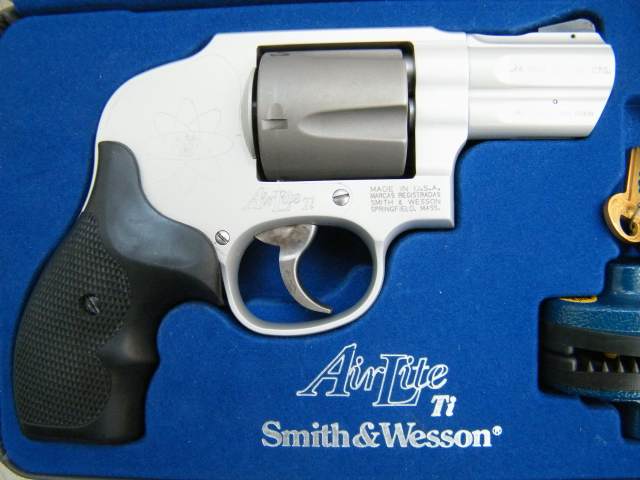
Smith of the Week: Tam's purse gun, S&W 296 DAO .44 Special

It's no surprise to my faithful readers, all dozen or so of you, that I love Smith & Wesson firearms. During the past year+ that I've working in a gun shop, I've had quite an education in the bewildering nomenclature of Smith handguns with two, three and four digit ID numbers established since the line got so large in 1958 that all models got numbers instead of names.
"They've given you a number,
"and taken way your name"
goes that song of the '60s from the TV show, "Secret Agent Man."

So I have decided for furtherance of my own education, as well as my faithful readers, that I shall henceforth begin a regular feature I shall dub "Smith of the Week" or maybe day or month or whenever inspiration strikes.

This inaugural post is dedicated to Tamara, who confided in a comment post when she visited my humble blog that a S&W 296 .44 Special has a permanent home in her purse.

Bluebook sez:
MODEL 296 AIRLITE Ti CENTENNIAL- .44 S&W Spl. cal., L-frame, 5 shot, 2 1/2 in. barrel, similar to Model 242 in construction materials, alloy frame and titanium cylinder, Uncle Mike's Boot grips, 18.9 oz. Mfg. 1999-2002.
Bluebook doesn't supply a photo and Tam didn't give me one, so I stole a couple of images from an auction on gunbroker for this post. It was available for a mere $999, so that puts if out of my league.

Aside from the fact that I love Tam from afar and greatly admire her gun knowledge -- what's not to love, a good lookin' woman who has a lot of guns and shoots them regularly and shares her knowledge? -- I also got the chance to actually hold and dry-fire a S&W 296 this week.

One came into the gun shop and when I picked it up and snapped it, lo and behold it has a great double-action-only trigger. It also has a really nice set of combat finger-groove checkered wood grips of the type used on Talo and other special-edition S&W round-butt revolvers.

But alas, it was purchased by a customer from afar who had it shipped to our shop for a transfer. My hope was I would be able to shoot it and perhaps add it to my humble collection of Smith's, but that is not to be, at least immediately.

The boss lady gave me hope after informing me it is for transfer and not for sale. She said this customer often purchases guns off the Internet, tries them out and then brings them back for resale. So maybe I'll get a shot -- literally -- at this 296 yet.

It's one of Smith's alloy frame, Titanium cylinder creations that is remarkably light for its size and shooting a respectable cartridge, certainly a lot more potent than .38 Special, and I am one of the many who love .44 Specials.

My hope, if I ever to get a chance to try it out, is that it will be more shootable than the S&W 396 Scandium-Titanium "Mountain Lite" that I once tried out at another gun shop that had a range.

One writer I read termed it the "Mountain Bite" and after five rounds of full-house .44 Specials I had to agree with that assessment. It had a serious bite on the back end as well as the business end.

The 296 differs from the 396 in two regards, it is double-action-only not traditional double/single like the 396. And despite that Bodyguard-looking hump, it does have not a shrouded hammer but a fully enclosed hammer of the Centennial-Smith style.

And is seemed some gunsmith worked some magic on the trigger as it was very light and eminently shootable. Who knows if the recoil is "biteable"?

Tam likes it so it can't be too bad. Time will tell as to whether I ever get a chance to shoot this 296. But if not, it's something else I can be on the lookout for future acquisitions.

Thursday, April 8, 2010

Steyr-Mannlicher MA1, the Austrian pistol nobody has heard of

When I started looking around for a concealed-carry pistol in 2006, I ended up buying a Steyr-Mannlicher MA1 in .357 Sig.

That was more than a few pistols ago, but I'm still amazed today at how smart that decision was.

Since then, I've also bought Steyr MA1 .40S&W and 9mm pistols and two Glock 10mm pistols, G20 and G29, but I still say the Steyr is a superior design to the more-well-known Glock.

Both are striker-fired double-action only pistols with a steel slide and a polymer frame.

But the Steyr has a better grip angle, not as steep as the Glock and the best natural pointing pistol I've ever shot.

It also has a smoother, lighter-feeling trigger than the Glock, though both are rated at 5.5 lbs.

The Steyr also has a lower bore axis with a grip that sits the pistol lower in your hand and makes it more controllable firing.

And Steyr's trapezoidal sights, a white-outline trapezoid rear and a white-outline triangle front, are the quickest and easiest sight picture I've ever shot.

Steyr even uses the same Tenifer-finish steel slide as Glock, but their version of Tenifer is more brownish than the black Glock slide.

Steyr is that other Austrian pistol that nobody ever heard of because Glock has just been better at advertising and promotion from the get-go back when the G17 first hit the market in the early '80s.

Steyr didn't even start importing to the U.S. until 2004 so they'll never catch Glock now as the most popular plastic pistols with law enforcement and civilians.

But if you'd like to own an immaculate unfired M9-A1 9mm Steyr-Mannlicher, I just listed the one shown on gunbroker for $500. I like Glocks, but I love Steyr-Mannlicher pistols.

P.S. If you wanted this M9-A1 you're too late. It sold last night about midnight, 10 hours after I listed it on gunbroker. Steyr stopped importing any MA1 pistols into the U.S. in 2009 and has not said when importation will resume so the supply is getting very scarce.

U.S. Navy delivers justice to Somali pirates in Indian Ocean


Do not mess with the U.S. Navy. You'd think the rag-tag pirates of Somali, who love mugging defenseless commercial ships, would have enough sense not to bring a knife to a gun fight with the U.S. Navy.

But obviously these Somalis are not rocket scientists. Military.com quotes The Virginian-Pilot on the latest escapade by these clueless pirates.

The same week a Norfolk-based Navy frigate crew captured Somali pirates who fired on them, another Navy ship intercepted a group of pirates who tried to attack a tanker in the Somali Basin.

The destroyer Farragut was called to the scene of a Sierra Leone-flagged tanker after the ship came under attack by three pirate skiffs, according to a Navy news release. During the attack, the pirates fired rifles and aimed rocket-propelled grenades at the vessel. The Farragut is homeported in Mayport, Fla.

The tanker M.V. Evita was north and northwest of the Seychelles when the pirates tried to stop the ship, the Navy release says.

The ship evaded the pirates by increasing its speed and firing flares at them.

The captain called for help from maritime officials in Kuala Lumpur and Dubai, the release says. Coalition forces were contacted and a Swedish patrol aircraft located the pirates.

An SH-60 B Seahawk helicopter from the Farragut went to monitor the situation while the skiffs were boarded. The crew of the Swedish patrol aircraft watched as the pirates threw equipment overboard.

Eleven pirates were found aboard the skiffs and allowed to leave after coalition forces ensured they had no other equipment to conduct attacks.

The mother skiff was sunk.

On Thursday, the Norfolk-based frigate Nicholas took small-arms fire from suspected pirates in the Indian Ocean. The ship returned fire and captured five pirates.

I was stationed aboard U.S. Navy destroyers from Mayport, Fla., and Norfolk, Va., during my four years of service 1967-71, so I understand exactly how those sailors in the Indian Ocean felt when they got to call to take on some pirates. "Oh yeah, let's go have some fun with our guns!"

The two Destroyers cited, the Nicholas and the Farragut, both have the same main cannon used on the USS Mullinnix, DD-944, that I served on during the Vietnam War, a 5-inch 54 caliber automatic gun that hurls 70 lbs. of high explosive TNT 16-20 miles with deadly accuracy.

Match that up against a bunch of idiots in skiffs with small arms and it is no contest. Yee hah!

Sunday, April 4, 2010

Do not, repeat, DO NOT travel though New Jersey with a gun

If you're traveling with a gun via car, train, bus, airline, bicycle, motorcycle or shank's mare, take some good advice. Stay the hell out of New Jersey!

NRA's Outrage of the Week reports on a poor airline traveler passing through the Newark, N.J. airport with his locked-in-a-case gun per airline regulations and still ended up in the pokey.
After spending four days in a Newark jail cell, Revell was released on bail. Revell was eventually cleared of all charges, but he didn't get his firearm and other property back until almost three years later.
I heard of another case where some clueless hunters were headed up the Interstate with a long gun on a rack in the back window, which is required equipment in all pickups in Redneck country down where I live. They also had their hunting dogs in a travel kennel in the back of the truck.

New Jersey cops pull them for possession of the gun, lock them up and three days later when they finally make bail, they discover their dogs had died while locked unattended in the truck.

I say again, stay the hell out of New Jersey with your guns. Just don't do it.

And remember the New Jersey state motto: "Some of our politicians haven't been indicted yet."

Saturday, April 3, 2010

Charter Arms Southpaw gets a carry load: Federal HydraShok +Ps

Spent some more quality time at DeWitt's outdoor range today with the main objective being determining a carry load for my new Charter Arms Southpaw .38 Special.

It's a lightweight 5-shot J-frame size revolver so I was expecting what American Rifleman's review termed "stout recoil" with +P loads.

But contrary to their terminology, I found the +P loads to be a bit stiff but not unpleasant at all, certainly quite manageable. I tried three different loads, Hornady Critical Defense .38 Spl. 110 gr. FTX and two +P loads, CCI 125 gr. TMJ and Federal Premium 129 gr. HydraShok JHP.

The gun shop is out of the Critical Defense +P loads so I will try those when they're back in stock. The regular .38 Critical Defense loads are the five holes low and left in the first target on the left. The next five in that target, three in the black and two in the bull, are the CCI +P 125 gr., obviously more to point of aim of the iron sights, standing at 10 yards.

So I changed over to the Federal HydraShoks for the target at the right, 10 rds. same distance. Five in the black and five close by. Viola! We have a carry load.

It's gonna take a while for me to get used to a lefty-friendly revolver with the cylinder lock on the right instead of the left. But I like it. A lot.

Then I moved on to my Dan Wesson .22LR revolver, shooting from a rest to zero its sights. I've had the Dan Wesson way too long to just now getting around to zeroing the sights, but I've been pretty busy. That's my Sig P220 next to the DW, ready for testing of Winchester Ranger T .230 gr. JHPs.

First target on the left is testing and adjusting the sights of the DW. Like a fool I fiddled with the up-down adjustment while trying to get the left-right fixed. Finally figured out you have to hold the flathead screw while tightening the Allen screw. Who knew?

Then I shot a magazine of Ranger T's at the target on the right, standing 10 yards. Shot too fast but the test was mainly to see if they would cycle. Yes.

Then I fired three magazines of MagTech 230 gr. FMJs at the next target on the left, 10 yards rapid fire standing, just because.

I seemed to be shooting a bit low today so I slow-fired the target at the right with Ranger Ts. Some in the black, but most a bit low. Close enough for government work.

The gun shop has a pretty good supply of Ranger T ammo, 50 rds. of quality JHPs for only $34 a box, so I'll be stocking up on them. Anytime you can get quality hollow-points for less than a buck a round, buy 'em. And if they're Ranger Ts, well duh. That's one of the best law-enforcement rounds ever manufactured.

I only have one complaint about the Sig P220. It goes into slide-lock way too fast, as in "Damn! Is that eight rounds already?" It's one of only two single-stack pistols I own, the other being my itty bitty Kel-Tec PF-9 and when you're shooting +Ps in it, you're glad when it goes to slide-lock.

I like high-capacity pistols but this Sig P220 is making me take a second look at single-stacks.

Friday, April 2, 2010

Church of the Holy Sepulchre and Garden Tomb have empty graves

On this holiest of holy days, Wesley Pruden writes of the one place in the entire Middle East where Christians, Jews, Muslims and believers in all religions are free and protected to gather together to worship in their own way, in Israel.

The Israeli Declaration of Independence, adopted in 1948, declares Israel to be a Jewish state, but further declares that the nation "will ensure complete equality of social and political rights to all its inhabitants, irrespective of religion, race or sex; it will guarantee freedom of religion, conscience, language, education and culture; it will safeguard the Holy Places of all religions." It's a promise bereft of Jeffersonian eloquence, but it's plain and to the point.

In that long-ago day, in a burst of naive enthusiasm, certain idealists imagined that this example would spread to other places where religious freedom is understood to mean that you have the freedom to keep your head so long as you believe what the imams in the government tell you to believe. Israel has since enacted comprehensive legal codes to protect the hundreds of Christian, Muslim and Jewish monuments and markers and to guarantee universal access to them. Jordan, before the Six-Day War in 1967, controlled Jerusalem, and Jews were forbidden entry. Many Jewish holy sites were routinely vandalized.

Moshe Dayan, the defense minister who led the Israelis to victory in the Six-Day War, was clear about religious tolerance and protection in a radio broadcast the morning Jerusalem was captured. "This morning," he said, "the Israel Defense Force liberated Jerusalem. We have united Jerusalem, the divided capital of Israel. We have returned the holiest of our holy places, never to part from it again. To our Arab neighbors we extend, also at this hour - and with added emphasis 'at this hour' - our hand in peace. And to our Christian and Muslim fellow citizens, we solemnly promise full religious freedom and rights."

This clearly includes the right to disagree. Not every Christian regards the Church of the Holy Sepulchre as the site of Christ's burial. A tomb in a garden below Calvary was discovered in 1867 and, popularized by Gen. Charles George "Chinese" Gordon, an eccentric Bible scholar once assigned to the British military in Palestine, became known as "the Protestant tomb." The Anglican church once recognized it as the authentic tomb. Scholars are divided today on whether this is so.

The tomb fits the description in Matthew 27:58, when Joseph of Arimathea begged Pilate for the body of Jesus: "Then Pilate commanded the body to be delivered. And when Joseph had taken the body, he wrapped it in a clean linen cloth. And laid it in his own, new tomb, which he had hewn out of a rock; and he rolled a great stone to the door of the sepulcher, and departed."

The stone is there today, and the track on which it was rolled away is visible in the rock. The tomb and the garden lie beneath a large stone outcropping, vaguely resembling a skull, marked by two gaping holes, as if eye sockets. Hence the name "Golgotha," or "skull," given to the site of the crucifixion.

The argument continues, as with so much about the meaning of the Scripture. But Christians agree on the Resurrection as the story of Easter, the central fact that gives the Gospel meaning. The pilgrims continue to make their way in peace to Jerusalem, scene of the holiest and most horrific events of history, watched over now with respect and reverence by Jews.

I was privileged to get the chance to visit Israel on a Holy Land Tour in 1979 and I visited both the Church of the Holy Sepulchre and the Garden Tomb, the so-called Catholic and Protestant versions of the tomb of Christ. I have to say I felt no moving of the Holy Spirit in the Catholic church there but quite the opposite at the Garden Tomb. There was a flood of the Holy Spirit in that place which in my subjective opinion validates it as the genuine tomb.

So I agree with General Charles "Chinese" Gordon, photo above, who we were told discovered the Garden Tomb while strolling on top of the city wall one morning in his daily prayer walk.

Gordon had the Garden Tomb site cleared and sponsored its development as the holy site it is today, we were told. But I'm not trying to pick a fight with my Catholic brothers and sisters. The important thing is, wherever Jesus was buried, He didn't stay there long. He is risen!

"On a hill far away, stood an old rugged cross..." 2000 years ago today

Is it illegal to steal on Good Friday? Of course it is, so I must confess, I stole this from Bible Gateway.

Reflections on Good Friday

Today is Good Friday, the bleakest moment in the Gospel story. Reading the story of Jesus’ arrest, trial and crucifixion today, we have the benefit of knowing that it’s all leading up to the triumph of Easter. But to the Jesus-followers present at the scene, it must have seemed that the world as they knew it was falling apart.

One of the challenges of reading the crucifixion story two thousands years after the event took place is that it’s difficult for us to empathize with its participants. From our perspective, the Easter crowds seem insanely fickle; Jesus’ disciples seem utterly clueless; the members of the Sandhedrin contemptibly evil; Pilate laughably corrupt.

Those things are true. Nobody except Jesus behaves well in the Good Friday story. But it’s these very people—fickle, clueless, evil, corrupt—that Jesus died for.

The truth is that we have much in common with the fools and villains of Easter. The wonder is that Jesus loved them, and us, enough to submit to foolishness, injustice, and death. The miracle is that three days later, he rose from the dead to offer us salvation. Hallelujah, what a Savior!

If you haven’t read the complete story of the crucifixion recently, today’s a perfect day to revisit it. Here are the four Gospel accounts of the story:

Truth be told, there's a little bit, or even more than a little, in all of us in each of the characters in the Easter story. Hypocritical Jewish Priests and Sanhedrin members who were holier-than-thou but plotted murder of an innocent man who threatened their hold on power, fickle crowds who said "Hosanna to the King!" one day and "Crucify him!" a week later, even fickle disciples who swore they would all die for Jesus and then fled like scared rabbits when he was arrested. My prayer is this Easter we will all become more like the one real hero of Easter, the Lord Jesus Christ. Philippians 2:5-9 says let the mind of Christ be in you. "Let" means it's up to us whether we will allow the mind of Christ to be formed in us. Jesus has already done His part.
5 Let this mind be in you which was also in Christ Jesus, 6 who, being in the form of God, did not consider it robbery to be equal with God, 7 but made Himself of no reputation, taking the form of a bondservant, and coming in the likeness of men. 8 And being found in appearance as a man, He humbled Himself and became obedient to the point of death, even the death of the cross. 9
Happy Easter!

Thursday, April 1, 2010

Massad Ayoob traces history of S&W Model 27 .357 Magnum

My favorite gun writer excerpts from his new book, Massad Ayoob's Greatest Handguns of the World in Gun Digest with his entry for the fabled S&W Model 27 .357 Magnum.
In 1935, Smith & Wesson and Winchester announced a new revolver and a new cartridge simultaneously. Both would bear the same name. The cartridge would go on to become one of the most popular in the history of handgunning. The revolver would also be a milestone. More than 20 years later, it would get a mundane new name: “Model 27.” But until then, it would be known simply as the “Smith & Wesson .357 Magnum.”
Gorgeous finish, “neutral balance,” and  built-in accuracy made the Model 27 a long-lasting classic.
Gorgeous finish, “neutral balance,” and built-in accuracy made the Model 27 a long-lasting classic.

To many purists, this model would forever be the Smith & Wesson .357 Magnum.

Finely checkered topstrap and barrel rib were  trademark features of the Model 27.
Finely checkered topstrap and barrel rib were trademark features of the Model 27.
From its beginning, the revolver we now call the Model 27 (if only to distinguish it from its long list of descendants and stable-mates in the same caliber) was welcomed and then almost universally endorsed by gun experts. The ones of its time, and the ones that followed.

The great Elmer Keith, of course, cheered its creation: he was a part of that, as we shall see in a bit. Charles Askins, Jr., carried one with a 4-inch barrel for a good part of his career on the United States Border Patrol. “This is the most sturdy revolver in the world,” Askins wrote. “As a service weapon it is tops! A very great deal of care goes into the production of each weapon; they are in fact custom made.”

The most enthusiastic ambassador of the new gun and cartridge was a member of S&W’s ruling family, Douglas Wesson, who had worked on the .357 Magnum project. Wrote Keith, “Major Wesson hunted big game and killed elk, antelope, moose and one grizzly with his 8-3/8 inch .357 Magnum.”

Later experts shared the appreciation. One was Henry M. Stebbins, who in 1961 noted that shooters were only then becoming adjusted to its power level. “When it came out in 1935 it was terrific enough to frighten some of us a bit by its noise and recoil,” he admitted. “Since then it has done much to educate us as to the amount of such ruction that we can stand and still do effective shooting...what used to seem a ferocious gun is accepted in handgun society today, with almost everyone agreeing that it has its points.”

With today’s iterations of the 27, you can  put eight rounds downrange before reloading.
With today’s iterations of the 27, you can put eight rounds downrange before reloading.
But more experts than those who wrote for gun magazines learned to appreciate the big Smith .357. George S. Patton bought one before he went overseas in WWII, embellishing it with his trademark ivory stocks bearing his inlaid initials. When he gave away one of his matched Colt Single Action Army revolvers to a Hollywood star, he augmented the remaining .45 with the Magnum, which he called his “killing gun.” Patton’s weapon had a 3-1/2-inch barrel. So, legend has it, did the very first .357 Magnum to leave the factory, which was presented to FBI director J. Edgar Hoover, though some who study the history of S&W insist it had an 8-3/4-inch barrel.

Many agents bought identical revolvers for themselves, with the 3-1/2-inch barrel, or the 4-inch that Askins preferred. Among those with the 4-inch .357s was Walter Walsh, the legendary FBI agent, fast draw ace, and pistol champion. One day in Maine in 1937, Walsh shot it out with the notorious Brady gang. Armed with a Colt .45 automatic in one hand and his Smith & Wesson .357 Magnum in the other – and with a .45 slug through his own chest, collapsing a lung – Walsh used the .357 to kill gang leader Al Brady. Ed McGivern, the famed six-gun wizard of the period, often used one in his demonstrations, and repeatedly shot man-size targets with it at distances out to 600 yards.
Read the whole thing at Gun Digest.